Showing posts with label sales excellence. Show all posts

Tuesday, April 15, 2025

Mindset Matters


If you think you can, you're right!

If you think you can't, you're right!

Mindset matters a lot, and whether we have a growth mindset or a limiting mindset, we have room for improvement!

We aren't born with limiting beliefs. The young person's mind is a blank slate. The child wants to know "why"; to make sense of the world, to explore, to grow.

Then someone tells the child to "shush", to speak only when spoken to, that they don't belong here, that they have to behave a certain way, or that they won't amount to anything. I learned to be the class clown. It was my way of both getting attention and to hiding out. And it took many years for me to learn to take that mask off.

These beliefs are reinforced over time. The programming takes a set and we carry the beliefs forward into school and our careers. So much of what we do day-to-day, now, is based on the programming we received as young children.

And...that programming was delivered without intent, good or bad...just a passing comment from another person, perhaps a parent or a teacher. Something someone said casually to a five year old, without thinking, or really meaning anything...

The first step is to acknowledge that inner voice, the critic, the judge or saboteur.

Yes, I hear you.

The next step is to recognize that it is just a voice, a simple program running in our mind that can be erased and replaced with programs that serve rather than constrain us.

It's not who we are.

Yes, I hear you. Thank you for sharing. Now...go away, I have important things to do.

That voice who says "we are not good enough" or "we can't do it" or "we don't belong here" or "we are not worthy"...is just a voice. It's just old programming that never was relevant and certainly isn't relevant today.

Let it go!

We have work to do. If we are clear on our purpose, that inner critic gets drowned out by the roar of our purpose. My purpose is to help people transform and anything that doesn't help me to accomplish that purpose is just noise, to be ignored.

Authenticity

In sales, authenticity is critically important, just as important as curiosity. If we are authentic and curious and listen, we become trusted partners to our customers.

I work with principals of service organizations who have difficulty being authentic. They believe that they cannot sell, they don't want to be the caricature of the sales person, to be that guy!

And this belief, this programming, this internal saboteur keeps them from authentically sharing the passion for their services. When they let that image, that programming go, engagement with prospects increases dramatically and revenues skyrocket.

Similarly, I find many sales people, from SDR to key account director, harboring negative programming:

SDR: "I have nothing to offer an executive...I hope they don't answer the phone!" (How will that conversation go?)

Field rep: "I don't know all the technical details." (Your job as Listener in Chief and choreographer is to guide the customer through the process and connect them with technical and other resources)

KAD: "My job is to fulfill demand." (If that were your job, you'd be a fax machine!)

As sales people, our job is to be curious, to listen, to develop a point of view, to help the customer to see new opportunities. A negative mindset constrains us from playing all out in the game of improvisation that is high level sales.

A growth mindset allows us to take a longer view, to keep the customer's needs and goals in mind and to focus on helping them to be successful.

When they win, we win.

Our growth mindset allows us to connect with our customer's goals and initiatives.

When managing a key account team calling on Merck, I showed the team a "Merck for Mothers" banner displayed in the lobby at the company's headquarters. As part of this campaign Merck committed $650 million to ensure that no woman has to die while giving life.

We had a conversation about the banner, its impact on employees walking through the door each morning, and how the team can align to support that purpose. As a result, our conversations switched from the focus on middleware and CRM and databases to how we could better support the global Merck initiative.

Your intent is written on your forehead

When our intent (or context) switches from "we want to sell you some stuff" to "we understand and support your strategic initiatives," both organizational and personal, it's visible.

Our intent comes through every word, every statement, every body movement. Customers know exactly what we're up to, what we're working towards, how we'll treat them in the short and longer term.

Together We Win

My personal intent (or context) is usually "Together We Win."

As someone who runs partnerships, delivers global sales enablement, coaches sales people and teams...I must work in partnership with others to deliver impact. In that partnership, I find dramatic leverage.

Even if we don't consciously set our intent, we always have specific, visible intent or context. Sometimes it's a simple "I have no freakin' idea" or "I can't wait to be done with this." When we do consciously set our intent, it's much more powerful!


Do this next!

Step one is to actively listen for that limiting self talk, that inner voice, the inner judge/critic/saboteur. (There's also an inner sage; we'll leave that for another time.)

When you hear that inner voice -- the one right now saying "what inner voice" -- just acknowledge it. "I hear you." That first step reduces its power and allows us to begin reclaiming our own power, autonomy, and joy!

For some, it only takes a few moments to completely eradicate that negative programming. For others the programming is so deeply ingrained into our belief of who we are that it can take longer.

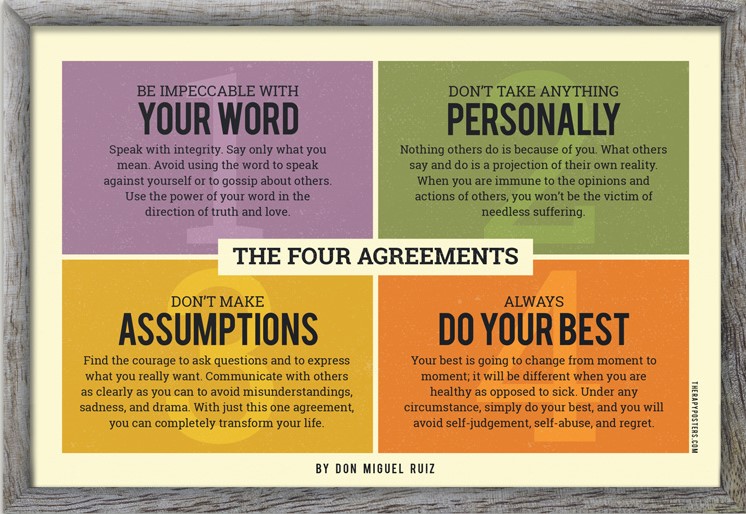
Step two is to begin the work on your Inner Game. I'd suggest reading The Four Agreements by Don Miguel Ruiz. While it's not specifically a book on sales, it is one of the best regarding mindset.

If you've already read it, then please reread it. Each time you'll bring new context to the reading and take away new learnings. I've reread it twice in the past year alone!

Need help?

If you need help building your positive mindset and the accompanying practices and habits that drive better customer engagement and results, please reach out to schedule an initial conversation.

Schedule time to talk now!

Wednesday, July 26, 2023

108 Selling Days Left in 2023!

With the end of the year fast approaching, now would be an excellent time to review the influence map with the team for each important deal and to take action now on your learnings.

  • Have all the decision makers and stakeholders been identified?
  • Have all the influencers been identified, including partners and service providers (the answer is always no!)
  • For each of these individuals, how strong is the relationship? What direction is the relationship moving -- getting better, staying the same, getting worse?
  • Who can say no...and why?
  • When was the last time you significantly engaged with each of the important players on your influence map?
  • What is your plan for improving relationships where necessary and getting commitments from each of those stakeholders and decision makers?
  • If there is an incumbent to be displaced, what does their influence map look like and how much overlap is there with yours?
  • What are your coaches telling you now?

The influence map is a key tool to help de-risk opportunities. If you leverage the influence map as part of your engagement and pursuit process, you are winning at a 20 to 40% higher rate and seldom, if ever, need to discount at the eleventh hour to close/win deals.

And if you aren't yet using influence maps, and would like assistance in implementing them, let me know!

While powerful, the influence map is just one part of a professional enterprise selling toolkit. I'll cover additional high value tools in coming days.


Thanks,


Lee


Wednesday, May 31, 2023

Hey, Lets Do Value Selling

Over the past few months, a number of senior sales leaders have reached out for help, stating "we want to implement value selling."

They see value selling as a tool to unlock more value (revenue) or to improve their pipeline or to gain a competitive selling edge.

They are on the right path...value selling can certainly have a net positive impact on revenue, pipeline and competitiveness.

However, their perception of value selling and how it's implemented is a bit short sighted. Value selling is not a thing. You don't "implement value selling." 

Value Selling Is Not a Tool

First and foremost, value selling is not a tool; rather, it's a mindset. Value selling is a way of thinking about how to engage with customers and requires a broad organizational commitment to putting the customer first.

Value selling focuses on the customer's strategic business goals (not technology habits). It focuses on the firmagraphics (the culture) of the buying entity (first mover/late adopter, risk taker/risk adverse, etc). It considers the needs/wants/desires of the individual stakeholders and contributors to the buying process. Value selling requires a specific focus on the use of language to align with those entities.

As a result, value selling is not something easily boiled down to Step One, Step Two, Step Three...

Instead, a value selling approach should be baked into onboarding, selling preparation, communications, actions and activities. And it requires an organization-wide change management process.

Start With Opportunity and Account Planning

Opportunity planning and development, and its cousin, account planning, are great places to start. 

Traditional opportunity planning starts with a profile of the target customer (focusing on installed base and potential budget) and the questions "what can we sell them and how much share can we steal from a competitor?" As this approach is highly transactional and competitive, it leads to sales with low profitability and mediocre customer satisfaction ratings. Sound familiar?

Value centered opportunity planning also starts with a profile of the target customer, but with a focus on strategic business goals, the gaps between goals and capabilities and the motivations of the organization and the key stakeholders. Reps or teams consider how they can help the organization to achieve these goals, independent of any product or service offering (Solution development comes much later.)

Value selling involves co-creation with the customer, and in many, perhaps most cases, doesn't have much impact on existing vendor relationships. It tends to focus on net-new value creation, generating far larger impact and results than a simple vendor substitution might.

There's no comparison of vendors' TCO in value selling. It's just not relevant. That's pocket fluff in comparison to the impact true co-creation offers. Why focus on shaving 10% in operating costs if the project could lead to a 20% increase in customer satisfaction or manufacturing quality. Most of the senior executives, the decision makers in a strategic project, will focus on the latter.

The team must consider "are we well positioned to help the customer achieve their goals?"  Once the organizational goals are identified, the reps or teams develop an influence map that details the key stakeholders, the strength of the relationships, and an action plan to further develop those relationships.

Finally, the team develops powerful messaging that emphasizes alignment and ability of the team to help the organization achieve their strategic goals, and the ability of the individual stakeholders to meet their personal goals.

As with any strategic sales improvement project, the assistance of a knowledgeable sales enablement sherpa to provide direction and to carry the load is critical. If you don't get value selling right the first time, you won't get a second chance. Senior management...and the sales team...will move on to other shiny new objects.  

Thanks!


Lee


Thursday, May 25, 2023

Abandoning the Hero Sale

When companies first get started, the founders may do most or all of the selling. They have the vision, the passion, the depth of knowledge of the service or product and connect well with early adopters.

At some point the Hero Sale risks becoming the Hero Fail. The challenge is that as the business expands, the founders (the heros) need to focus on running the business, managing the growth, courting investors, hiring managers, etc., and they have less time for selling.

So...they hire sales people. 

And they expect sales people to act and perform in their image, with the same depth of knowledge, passion, and ability to connect with mainstream customers.

I've seen and experienced it first-hand.

When I sold predictive analytics to some of the largest tech companies in the industry, the company president and founder expected the sales team to leverage his 100 page slide deck...to go deep into the technical details of the what and how of the platform. Much of our sales training focused on this technical deep dive, and only lightly touched on personas and messaging.

Conversely, my mainstream customers were only interested in the benefits of leveraging the platform - could they increase pipeline velocity, improve pipeline size and shape,  bolster their customer acquisition rates, meet their quota and revenue targets. The decision makers didn't care what was under the hood, only whether it would bolster their marketing results and how difficult it would be to integrate the predictive analytics platform and workflow into their existing marketing processes.

IBM wasn't even interested in the platform...they had their own...they were interested in our curated third party data. And we discovered this not through a detailed review of the CEO's slide deck, but in an extended white boarding session focusing on work flows. (White boards are my favorite selling tools.)

In talking with clients I hear many facing this same challenge...as the company grows, expected sales productivity fails to increase as experienced sales people are hired. And the founders question the new hires, the selection process, the target markets, everything but their own outsize influence in setting sales strategy.

Moving from a hero-driven revenue model to one that is sustainable and scalable requires a fundamental shift to a traditional selling model -- a formal selling methodology, selling processes, SFA and CRM platforms, formal onboarding activities. Dedicated sales managers will provide strong leverage for additional growth, particularly if a coaching methodology and mindset is part of the structure.

When I joined BAO, the outsourced inside sales organization, as its first sales leader, I implemented a formal selling methodology and spent a lot of time coaching my sales team on value selling techniques. Many had come from the delivery side of the organization and had been accustomed to a highly transactional sales approach...making up to 250 calls each day. The investment in time and effort paid off...we signed a number of key accounts that had been chased for fifteen years.

We also drove an increase in revenue of 75% over that first 18 month period.

Moving to this scalable selling model requires both support and patience from all of the key stakeholders. It won't happen all at once, and it does require a substantive shift in approach. The founders must step back and give the hired managers the space and time to do their job.

A formal approach to change management...and specifically...setting expectations with the key stakeholders will prove useful.

And maybe, just maybe, that hero can take their first vacation in four years.

Thanks!


Lee

Saturday, January 25, 2020

Practice, Practice, Practice!

I’m in the middle of rereading Peak Performance: Elevate Your Game, Avoid Burnout, and Thrive with the New Science of Success (link) and I was surprised at the common themes that help runners, artists, surgeons and sales people all excel at their craft.

If you’re interested in excelling at sales, follow these guidelines:

#1 Context is everything

If your intent is to get through 10 calls so you can check that box and go to lunch, the calls won’t be useful to you or the prospects. On the other hand, if your intent is to solve problems, make sense of the world, talk to interesting people, improve your craft…your calls will be much productive and fun. Your prospects will enjoy talking with you; they’ll share more, they will help you to help them.

Remember, your context (or intent) is obvious to your prospect, like it’s written across your forehead or broadcast in your caller id. You will always broadcast some context, either consciously or not, so ensure that it is a powerful, positive one. (Hmm, perhaps a topic for another posting…)

#2 Practice makes perfect

Athletes and musicians practice to ensure success. And they don’t just practice, they focus on specific skills, one at a time. A pro golfer will spend a week working solely on his putting game (but not from the same spot each time). An ultra-marathoner will focus on building leg speed. A top sales person will focus on practicing the pivot or bridge from one topic to another.

We practice to build “muscle memory.” When a prospect asks us a question out of the blue, because we’ve practiced, because we’ve built that muscle memory, we can pivot to addressing the question in a useful and meaningful way. Or maybe that question doesn’t catch us off guard…because we saw something on the contact’s LinkedIn profile and gave some thought to how that might be relevant…

#3 Learn from doing

Top performers always evaluate their performance. What went well? What could he or she have done differently? What’s the learning? What new muscle memory must be created?

After you talk with a prospect or customer, think about the flow of the conversation. Were you properly prepared? Did the conversation follow the path you expected? (Hint, it never does!) Did you accomplish what you intended? Were you open to solving different problems, uncovering and exploring different issues? Did you position yourself as a resource? Did you make a deposit in the relationship bank account? Did you reach agreement on a specific follow up?

This introspection is the single most powerful thing you can do each day to identify areas for improvement, to build your selling skills. For a deep dive into learning theory, spend some time with Make It Stick by Peter Brown (link). Peter also cites some pretty interesting research on new techniques for skill development (a topic for another post.)

Leverage your resources. Use the industry and persona information provided by your organization or public resources, the treasure trove of prospect information on LinkedIn, the call and conversation planning tools needed for thoughtful preparation. Corporate Visions cites industry knowledge as being critical to successful conversations, more important than company knowledge, and far more important than product knowledge. Prepare for success!

Practice, practice, practice. It might take you 30 minutes to fill out your first call planning template. It will take you 5-10 minutes to complete your 10th. Role play with your peers or your manager. Fine tune your conversational skills in a “safe” environment, make the mistakes in a coaching space where you will get immediate feedback. Practice your opening conversation in front of a mirror until it feels and sounds natural.
  
And pick up the phone often. You will have far greater success in holding an enrolling conversation with someone if you reach them by phone, versus trying to engage them by email. 

Thanks!

Lee